

At the beginning of October, Microsoft announced the general availability of GitHub-hosted agents and pay-as-you-go pricing in Azure Pipelines. For teams stuck with slow builds or parallel-job limits, GitHub-hosted agents are a useful new option that you can integrate into your workflow.
What’s new with GitHub-hosted agents
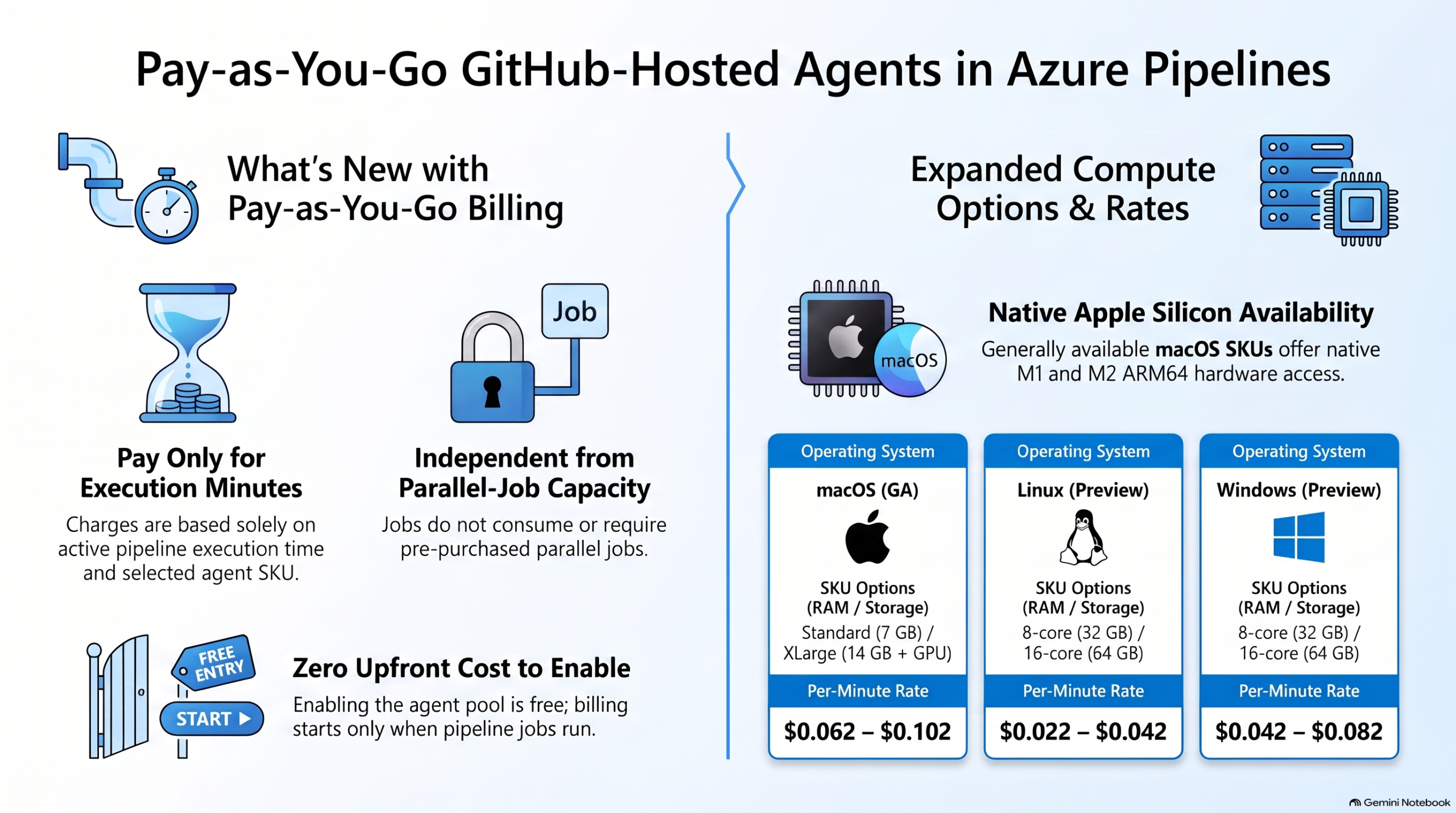
The new GitHub-hosted Agents pool sits alongside the existing Microsoft-hosted Azure Pipelines pool rather than replacing it. It runs on the same infrastructure as GitHub Actions and offers hardware the standard pool doesn’t: native Apple silicon Macs and larger Linux and Windows machines with up to 16 vCPUs and 64 GB of RAM. Each job gets a fresh, isolated virtual machine, and Azure reimages that machine when the job completes, so no state leaks between runs.
The new GitHub-hosted Agents pool runs alongside the existing Microsoft-hosted pool. This higher-performance compute gives teams access to larger Linux and Windows virtual machines and native Apple silicon macOS machines. Every job runs on a fresh, isolated virtual machine that Azure completely reimages after the job finishes.
The billing is the bigger change. With GitHub-hosted agents, you pay per minute of execution, at a rate that depends on the agent SKU you select, with no parallel jobs to buy in advance. Launch rates run from $0.022 per minute for an 8-core Linux agent to $0.102 for an XLarge macOS agent. The one caveat is that there is no free tier, but the pay-as-you-go structure gives you built-in cost control. You can track consumed minutes and financial metrics in Azure DevOps Pool Analytics and Azure Cost Management.
Where GitHub-hosted agents make the most sense
Apple platform development: Native Apple silicon with current Xcode images is the headline for mobile teams. If you build iOS or macOS apps, you no longer need to maintain your own Mac build hardware to get modern, fast agents.
Compute-heavy builds: Large monorepos, big test suites, container builds and anything that’s CPU- or memory-bound can benefit from 8 or 16 cores. Faster jobs often offset a higher per-minute rate, because you pay for fewer minutes. A build that drops from 40 minutes to 15 on a larger machine may well cost less overall.
Bursty workloads: With GitHub-hosted agents, teams whose demand spikes around releases no longer have to buy parallel-job capacity for the peak and let it sit idle the rest of the time.
Concurrency bottlenecks: Because these jobs don’t draw from your parallel-job allocation, they can relieve queueing for teams that have outgrown their current limits.
Adopting a new agent pool is easy, but integrating it seamlessly into your workflow takes some planning. Want to know whether GitHub-hosted agents will speed up your builds or lower your costs? For more information, or to get started,contact our team of experts here at PRAKTIK.